

Google SEO: what is actually worth improving?
Archived article with editorially revised content
The original 2016 article included assumptions about ranking at that time. A fast, mobile-friendly site still matters, but it does not replace quality content. Technical and editorial work support discoverability together.
Helpful content and accurate titles
Answer the visitor’s question rather than optimising for a keyword count. A page title should describe the subject; the meta description should summarise it without promising a position. Connect related pages with useful internal links. Give language versions separate URLs and correct language relationships. Social media can be a valuable communication channel, but a general Google+ or share-count bonus is not established.
Measure and improve specific problems
Search Console helps identify indexing issues and search performance, while PageSpeed Insights examines loading and user experience. Interpret laboratory tests separately from real visitor data. Fix incorrect redirects, missing content and unusable mobile interfaces first. A good score alone does not equal a good business outcome. Consistent improvement is more valuable than promises of rapid rankings.
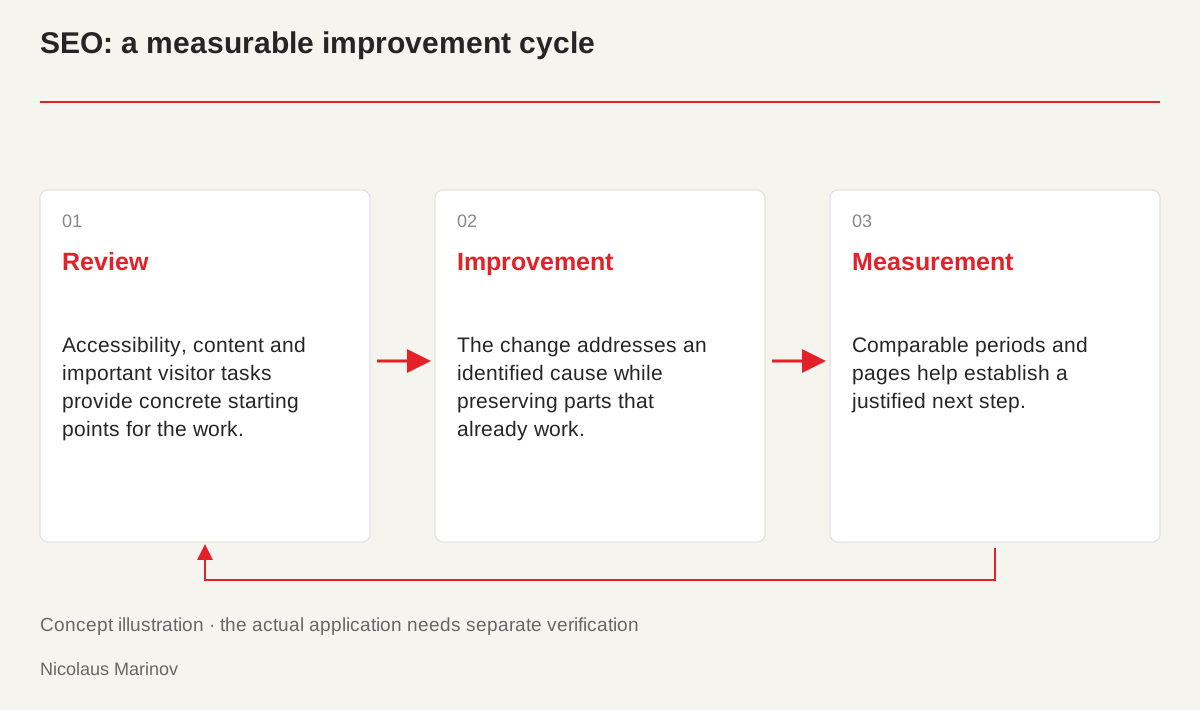
- Review: Accessibility, content and important visitor tasks provide concrete starting points for the work.
- Improvement: The change addresses an identified cause while preserving parts that already work.
- Measurement: Comparable periods and pages help establish a justified next step.
Establish an order for improvements
An SEO review may identify many small and large problems. Sort them by impact and effort. An unavailable service page or accidental indexing restriction usually comes before optimising a minor icon file. Choose important pages and concrete visitor tasks, then examine how they work. A precise list distinguishes developer fixes from editorial revisions. The technical report becomes an actionable plan rather than a long list of untouched issues. Priorities should fit the actual offer and explain why each change is useful now, instead of treating every automated warning as equally urgent.
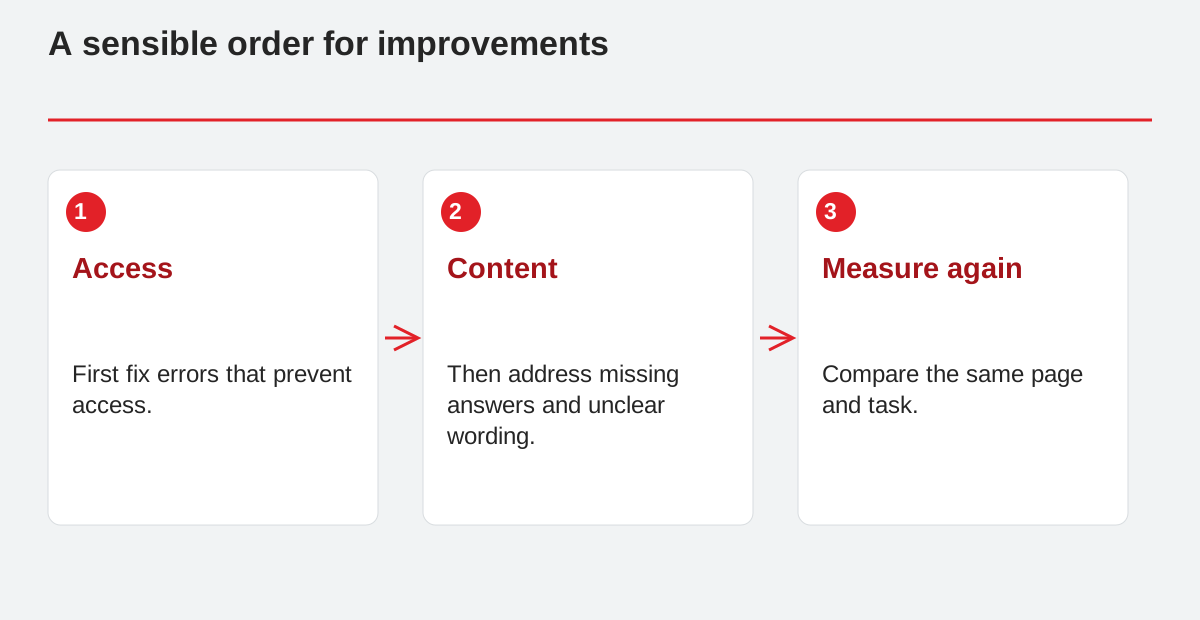
A sensible order for improvements.
- Access: First fix errors that prevent access.
- Content: Then address missing answers and unclear wording.
- Measure again: Compare the same page and task.
Connect the search presentation with the page
Titles and descriptions should not merely attract clicks; they should accurately represent the content that opens. If visitors receive something different from what they expected, an appealing label has not done its job. Give distinct services their own titles and useful introductions. Choose relevant imagery rather than decoration alone. Internal links should explain which question the next page answers. Coherent editing helps readers without requiring a hidden alternative version for search engines. Review the promise and the actual content together before focusing only on wording in the search result.
Match language versions accurately
A Hungarian article should link to the corresponding German or English article, not automatically to each language’s homepage. Translations need their own titles, natural copy and consistent URLs. Check language relationships alongside canonical signals. Review terminology, contact details and internal links in the actual text. A language label alone does not translate Hungarian content. Each version needs to form a usable page in its own right. Image descriptions and navigation labels also belong to that experience. Accurate matching allows people to switch language without having to start again at the beginning of the website.
Record and assess changes carefully
Note when titles, content or structure change. Compare Search Console and performance information for suitable pages and periods. A faster laboratory test does not automatically describe every visitor’s experience. Seasonal demand or another campaign may also influence the numbers. Do not attribute every movement to one SEO setting. Turn observations into the next specific task while preserving parts that already work. Continuous maintenance is more understandable than repeated complete redesigns without a clear reason. It leaves a record of what was actually tested and which expectations still need to be assessed.