

Why does a website need search engine optimisation?
Archived article with editorially revised content
Publishing a website does not automatically mean interested people will find it. Search engine optimisation, or SEO, helps search engines understand the site and helps readers find useful answers about the service they need.
Start with the visitor’s question
The objective is not to repeat keywords as often as possible. Explain what you offer, who you help and what supports a decision. Clear page titles, organised headings and natural internal links also give readers useful orientation. SEO and paid advertising have different roles: advertising may bring visitors sooner, while helpful organic content can build visibility over time. Neither automatically guarantees customers.
Technical foundations and measurement
The site should be crawlable, usable on mobile, reasonably fast and available through consistent URLs. Check that robots settings or incorrect redirects do not block valuable content. Search Console can show which queries display your pages and where indexing problems occur. Use this evidence to plan improvements; there is no secret recipe for a guaranteed first position.
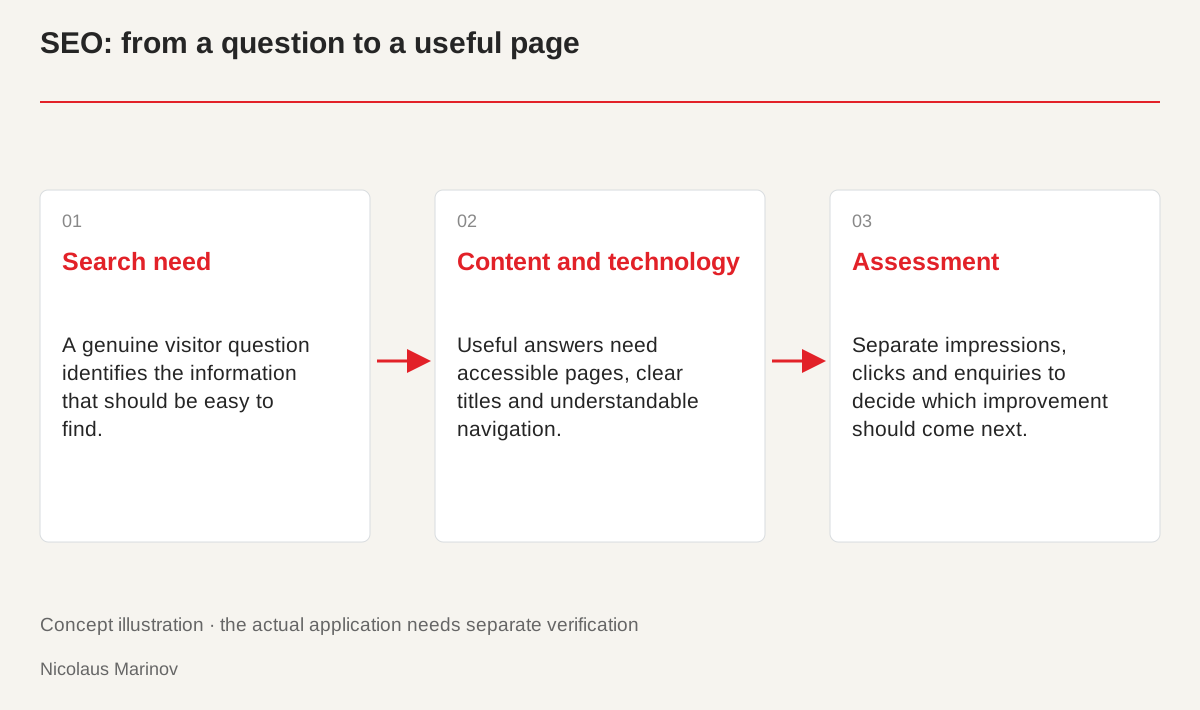
- Search need: A genuine visitor question identifies the information that should be easy to find.
- Content and technology: Useful answers need accessible pages, clear titles and understandable navigation.
- Assessment: Separate impressions, clicks and enquiries to decide which improvement should come next.
What makes a search result useful?
People usually want to solve a task. For a local service, availability, working area and the specific activity may matter. A specialist topic may need a detailed explanation instead. Begin by collecting genuine customer questions. Do not merely promise a quality service: explain when you can help, how the work progresses and what outcome to expect. Separate topic pages are useful when they contain their own information, not the same paragraph repeated beneath new headings. From this perspective, search optimisation begins with planning useful information rather than adding technical settings after the website is complete.
Make the technical foundation testable
List the important pages and check whether they can actually be opened. Valuable information should not exist only behind a difficult search interface. Navigation and relevant text links should provide natural routes to it. A development noindex setting accidentally left on the live site may conflict with your intention to have it indexed. A server failure or login restriction is a different issue from an inaccurate heading. Fix access problems first, then improve the visible copy. Separating technical causes from editorial work makes it easier to establish priorities and confirm that each change solved the intended problem.
Example: a workshop service page
A furniture-restoration workshop can describe its process, show documented before-and-after examples and explain which jobs it accepts. Customers then understand whether their furniture is suitable and what information they should send. A general paragraph packed with keywords offers less practical help. Images need meaningful descriptions, while the contact button should explain the next step. A more precise presentation of the real offer supports search visibility as well as the customer. Guidance about photographs for an enquiry or an initial assessment can connect the searcher’s question directly with a useful action.
Turn measurement into a practical task
Appearing in search, receiving a click and gaining an enquiry are separate events. Impressions without many clicks may justify reviewing the title and its relationship to the topic. Visits without further action can indicate uncertainty in the content, interface or offer. Do not judge performance from one day alone, and record when copy or navigation changes. Derive small, specific improvements: answer a missing question, repair a broken link or explain a service more clearly. This keeps SEO connected to observable work rather than a collection of promises that cannot be checked.

Three different measurement points.
- Impression: The search engine shows the page.
- Click: Someone opens the search result.
- Contact: A visitor actually gets in touch.